
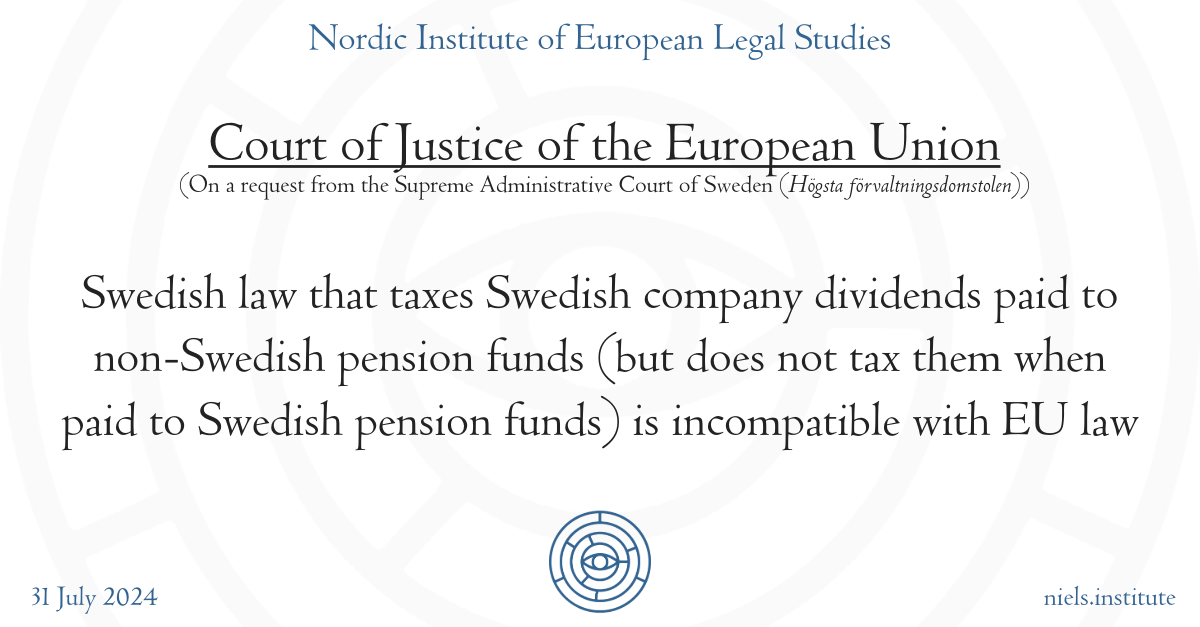
On Monday 29 July 2024, the Court of Justice of the European Union (CJEU) delivered its judgment in Case C-39/23, Keva, Landskapet Ålands pensionsfond, Kyrkans Centralfond v Skatteverket (Keva and Others), a free movement of capital case under Article 63 TFEU.
In Sweden, the state is exempt from tax obligation (Chapter 7, Article 2 of the inkomstskattelagen (1999:1229) (Law (1999:1229) on income tax). Given that Sweden has several ‘general pension’ funds are an integral part of the state, they do not pay tax on dividends received from Swedish companies.
The applicants in Keva and Others are pension funds based in Finland, and are forced to pay a Swedish withholding tax. The Finnish pension funds are public, and comparatively like Swedish pension funds, they do not pay exempt from Finnish taxation. Thus, the withholding tax they pay in Sweden of 15% is non-deductible, and thus, becomes ‘final’.
The case was referred to the CJEU by the Supreme Administrative Court of Sweden (Högsta förvaltningsdomstolen), where the CJEU was being asked whether this is compatible with EU law (the free movement of capital) or not. Factually, the case was intra-Nordic, given the fun looking to invoke its rights under EU law was based in Finland.
First, the Court stated the obvious restriction
‘difference in tax treatment leads to a disadvantageous treatment of dividends paid to non-resident pension institutions governed by public law, liable to deter those institutions from investing in companies established in Sweden.’ (para. 46)
Therefore, what was before the Court ‘constitutes a restriction on the free movement of capital, prohibited, in principle, by Article 63 TFEU.’ (para. 50).
Second, as regards whether whether the Swedish public pension funds and the Finnish public pension funds were in an objectively comparable situation or not, the Court stated,
‘the fact that such a pension fund is part of the Swedish State does not necessarily place it in a different situation from that of a non-resident pension institution governed by public law.’ (para. 55).
Given that ‘the payment of pensions and the legal form of the fund concerned do not appear to have a direct link with the tax treatment of the dividends received from Swedish companies‘ (para. 61), that, ‘the only criterion capable of distinguishing between pension funds governed by Swedish public law and non-resident pension institutions governed by public law is in actual fact the place of residence of the funds‘ (para. 62) Accordingly,
‘the difference in treatment between non-resident pension institutions governed by public law and resident pension funds governed by public law, as established in paragraph 46 above, concerns situations that are objectively comparable’. (para. 63).
In order words, contrary to what Sweden argues, the funds are comparable, and that no difference in tax treatment should be in place.
Third, whether there is a potential exception to the free movement of capital, in the name of an unwritten potential overriding reason in the public interest, the Court wasted little time in arguements advanced by Sweden. It stated that, ‘administrative disadvantages are not alone sufficient to justify a barrier to the free movement of capital‘ (para. 68), and, ‘where a Member State has chosen, as in the situation at issue in the main proceedings, not to tax resident funds on their domestic income, it cannot rely on the need to ensure a balanced allocation of the power of taxation between Member States in order to justify the taxation of non-resident funds which receive such income‘ (para. 73).
More bluntly, the Court stated,
‘the national legislation…[of Sweden]…at issue in the main proceedings cannot be regarded as compatible with the provisions of the TFEU on the free movement of capital on the ground that it is justified by an overriding reason in the public interest‘ (para. 75).
In conclusion therefore, the operative part of the judgment read:
‘Article 63 TFEU must be interpreted as precluding legislation of a Member State under which dividends distributed by resident companies to non-resident pension institutions governed by public law are subject to a withholding tax, whereas dividends distributed to resident pension funds governed by public law are exempt from such a withholding tax.’
The prior Opinion of Advocate General Collins, delivered earlier in 2024, more-or-less followed the same logic.
The judgment of the CJEU reveals something quite troubling about lower instance national courts in Sweden. Before the case reached the Supreme Administrative Court, two lower instance courts rejected the claims of the Finnish pension funds: the Administrative Court of Falun (Förvaltningsrätten i Falun) and the Administrative Court of Appeal of Sundsvall (Kammarrätten i Sundsvall). Given the obvious issue of EU law here, and the relative ease in seeing the restriction under the free movement of capital here, it is dubious why they did not make their own referrals to the CJEU in this case.
That, naturally, raises questions about the awareness of the rights of non-Swedish investors in Sweden, and how they can be protected from the very broad powers of Sweden’s tax authority (Skatteverket).
The judgment of the Court of Justice of the European Union (CJEU) in Case C-39/23, Keva, Landskapet Ålands pensionsfond, Kyrkans Centralfond v Skatteverket (Keva and Others) is available here.