
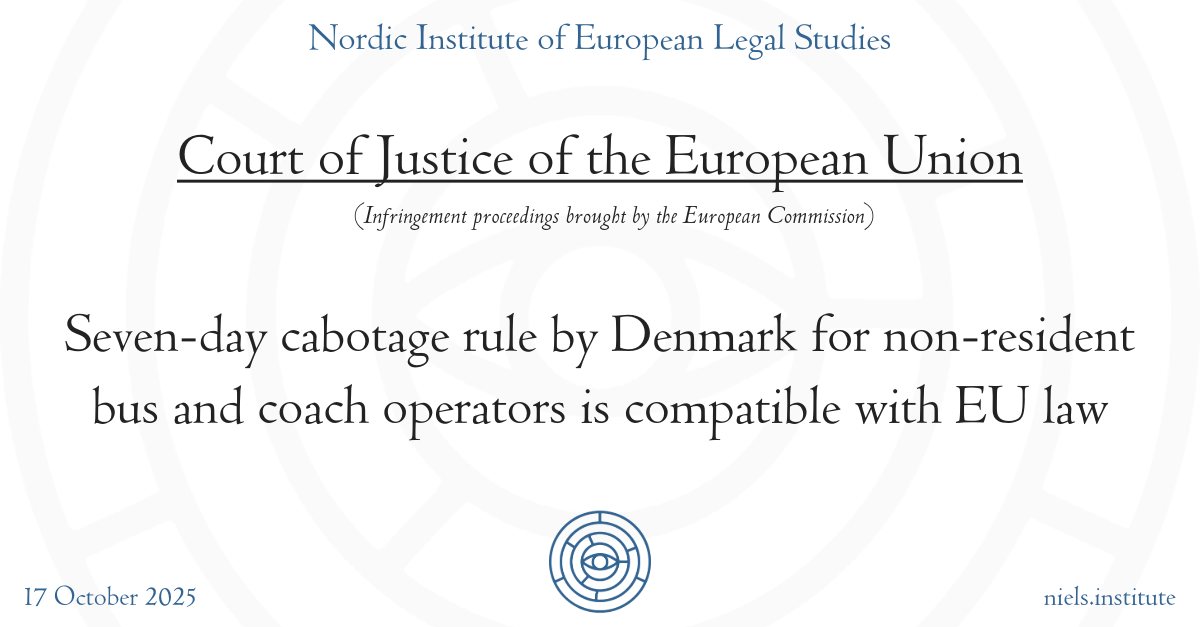
In Commission v Denmark (Cabotage transport) (Case C‑482/23), the Court of Justice of the European Union (Second Chamber) delivered its judgment on 16 October 2025. The case arose from an infringement action under Article 258 TFEU, brought by the Commission against Denmark.
At issue was Denmark’s interpretation of the term ‘on a temporary basis’ in the Bus and Coach Regulation (Regulation 1073/2009 on common rules for access to the international market for coach and bus services). Denmark had applied an administrative practice since 2019 limiting cabotage operations by non-resident carriers to seven consecutive days in one calendar month, a measure the Commission claimed violated EU law.
In its judgment, the Court dismissed the Commission’s action, holding that Denmark’s seven-day rule was compatible with EU law. It found that while EU regulations generally have direct effect, EU Member States may adopt measures of application where provisions are imprecise – such as the undefined concept of ‘temporary’ in the regulation. The Court ruled that Denmark’s measure was appropriate and proportionate, ensuring cabotage remains temporary, and does not become a permanent activity.
Background and Facts
Since November 2019, Denmark had applied an administrative practice limiting cabotage (operations by non-resident carriers in a single Member State) to seven consecutive days in one calendar month. This interpretation aimed to ensure that cabotage remained temporary and did not evolve into a permanent activity. The Commission argued that this fixed time limit infringed Article 15(b) of Regulation No 1073/2009, which authorises cabotage for occasional services, and violated the principle of proportionality.
The Commission, supported by the EFTA Surveillance Authority (ESA), maintained that the Bus and Coach Regulation provides carriers with the right to operate occasional services on a temporary basis, without imposing a rigid time frame. It claimed that Denmark’s rule effectively prohibited carriers from performing two cabotage operations in the same month ,if separated by more than seven days, even when those were the only operations performed.
Denmark, supported by Norway and Iceland, defended its approach, arguing that the Bus and Coach Regulation’s wording was imprecise, and leaves Member States discretion to adopt measures of application. It stressed that the seven-day rule ensures clarity, predictability, and prevents continuous operations that would undermine the temporary nature of cabotage.
Judgment of the Court
The judgment addressed three issues: (1) whether Member States may adopt measures to define “temporary” cabotage; (2) whether Denmark’s seven-day rule was permissible under EU law; and (3) whether the principle of proportionality was respected.
First, on the direct effect of regulations, the Court began by recalling its settled case-law on EU regulations, in that they generally have direct effect and do not require national implementing measures. However, where provisions are general or imprecise, Member States may adopt measures of application, provided they do not obstruct the regulation’s direct effect, or alter its nature as EU law.
Applying the direct effect of regulations under the case-law, the Court examined Bus and Coach Regulation, particularly Article 15(b) and other relevant provisions. These provisions, for the Court, define cabotage operations as national passenger services carried out ‘on a temporary basis’, and authorise such operations for occasional services. It stated, however, that the Bus and Coach Regulation does not specify any duration or frequency for these operations. The Court noted that this lack of precision indicates that national measures may be necessary to clarify scope. Thus, Denmark was entitled to introduce national law defining what constitutes ‘temporary’ cabotage.
Second, on the whether the seven-day rule in Denmark was compatible with the Bus and Coach Regulation, the Court found that, having established that EU Member States may adopt measures following on from the analysis of provisions the Bus and Coach Regulation, Denmark’s seven-day rule fell within its margin of discretion. Denmark argued that the rule ensures cabotage remains temporary, and prevents non-resident operators from establishing a permanent or quasi-permanent presence in the EU Member States. It also drew analogies with another EU regulation on freight transport, which uses a seven-day reference period for cabotage operations.
The Court emphasised that the objective of the Bus and Coach Regulation, as stated in the preamble, is to guarantee freedom to provide services, while respecting the temporary nature of cabotage. It further acknowledges that non-resident carriers may operate national services, subject to EU law and national law. Against this backdrop, Denmark’s measure was deemed appropriate for achieving the aim of the Bus and Coach Regulation: preventing continuous operations that would undermine the temporary character of cabotage.
Third, the Court made a proportionality analysis, given it was an infringement procedure (which it would ordinarily leave to the referring national court in reference for a preliminary ruling cases). The principle of proportionality requires, inter alia, that national measures must be suitable for achieving the objective, and not go beyond what is necessary that objective. The Court found that the seven-day rule effectively prevents continuous cabotage, and ensures operations remain temporary, and that by imposing a time limit, Denmark guarantees that non-resident carriers cannot operate indefinitely in the EU Member State, thereby aligning with the purpose of the Bus and Coach Regulation.
The Court also examined whether the measure was excessively restrictive. It noted that the seven-day rule does not prohibit carriers from performing international services or cabotage in other EU Member States during the waiting period. Thus, while carriers may face scheduling constraints, they retain significant operational flexibility. The Commission argued that less restrictive alternatives existed, but failed to specify what those alternatives would be. Therefore, the Court concluded that Denmark’s measure did not exceed what was necessary, and complied with principle of proportionality.
Read the judgment
The judgment of the Second Chamber of the Court of Justice of the European Union in Case C-482/24, Commission v Denmark (Cabotage transport), delivered on 16 October 2025, is available to read here.