
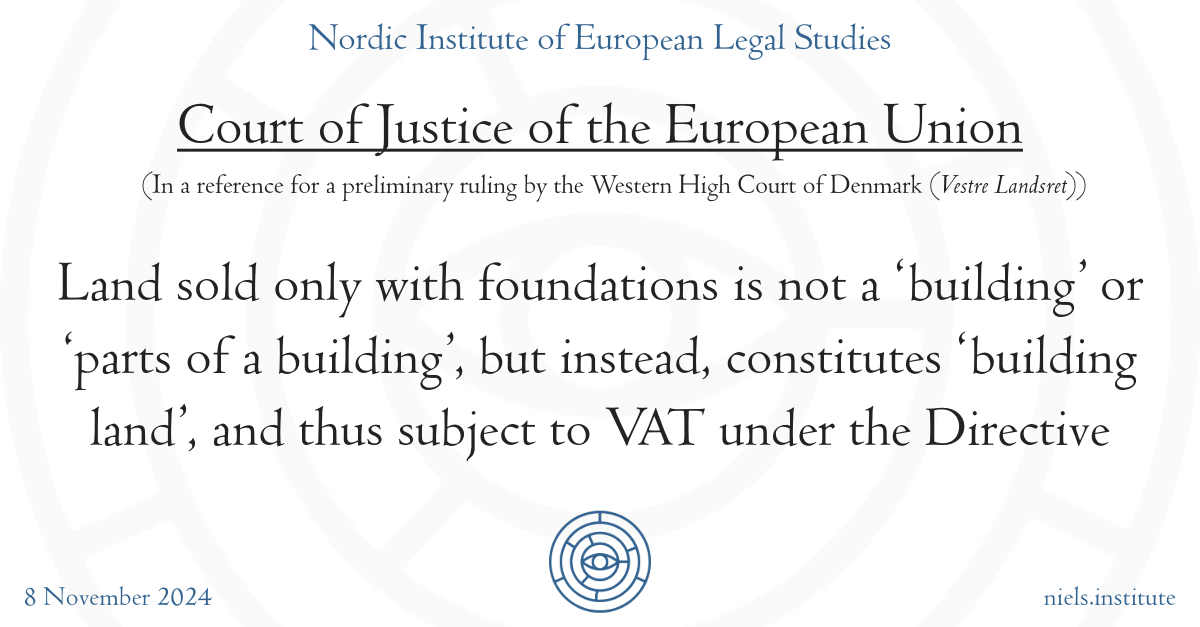
The Court of Justice of the European Union has delivered its judgment in Case C-594/23, Lomoco Development and Others, referred to it by the Western High Court of Denmark (Vestre Landsret).
The Court ruled that land with only foundations does not constitute a ‘building’ or ‘parts of a building’ under Article 12 of the VAT Directive. Thus, such land only with foundation constitute ‘building land’, and thus, if sold, is subject to value-added tax.
Background and facts
The dispute arose between the Ministry of Taxation of Denmark (Skatteministeriet) and several companies, including Lomoco Development, regarding the VAT classification of land with only the foundations of residential housing structures in place.
In 2006, one of the companies acquired an immovable property previously used as a camping site. By 2008, it had divided this property into several plots, and in January 2009, they installed connections for essential utilities such as electricity, water, heating, and sewerage on some of these plots. In the autumn of 2010, the company began casting foundations on some of these plots based on building permits obtained from the competent authority. These foundation works were completed before 1 January 2011.
In 2015, the company transferred ownership of 16 plots with foundations in place to a company governed by Danish law, which subsequently sold these plots to individuals. Of these 16 plots, residential housing structures were erected on the foundations of five plots, while on eight other plots, structures were built, but not on the original foundations. The remaining three plots retained the foundations cast in 2010 without any further construction.
In 2017, the Danish Tax Authority (SKAT) decided that the original company must pay VAT on the supply of these 16 plots, classifying them as ‘building land’ subject to VAT.
Initial national proceedings
The company challenged this decision before the National Tax Tribunal (Landsskatteretten), which in September 2021, ruled the supply of these plots did not constitute a transaction subject to VAT. It overruled SKAT, in favour of the company.
The Ministry of Taxation challenged the National Tax Tribunal’s decision by bringing an action before the Aalborg District Court (Retten i Aalborg). Due to the questions of principle involved, the case was transferred to the Western High Court. That court referred the case to the CJEU.
Applicable law
The case concerns the interpretation of the Articles 12 and 135 of Directive 2006/112 (the VAT Directive).
Article 12 of the Directive states,
‘1. Member States may regard as a taxable person anyone who carries out, on an occasional basis, a transaction relating to the activities referred to in the second subparagraph of Article 9(1) and in particular one of the following transactions:
(a) the supply, before first occupation, of a building or parts of a building and of the land on which the building stands;
(b) the supply of building land.
2. For the purposes of paragraph 1(a), ‘building’ shall mean any structure fixed to or in the ground.
Member States may lay down the detailed rules for applying the criterion referred to in paragraph 1(a) to conversions of buildings and may determine what is meant by ‘the land on which a building stands’.
Member States may apply criteria other than that of first occupation, such as the period elapsing between the date of completion of the building and the date of first supply, or the period elapsing between the date of first occupation and the date of subsequent supply, provided that those periods do not exceed five years and two years respectively.
3. For the purposes of paragraph 1(b), ‘building land’ shall mean any unimproved or improved land defined as such by the Member States.’
In other words, this defines taxable transactions and exemptions. Article 12(1)(a) and (b) allows Member States to tax the supply of buildings before first occupation and building land.
Article 135(1) of the Directive states
‘Member States shall exempt the following transactions:…
…(j) the supply of a building or parts thereof, and of the land on which it stands, other than the supply referred to in point (a) of Article 12(1);
(k) the supply of land which has not been built on other than the supply of building land as referred to in point (b) of Article 12(1);‘
In other words, this exempts the supply of buildings and non-building land from VAT.
The key legal question was whether land with only foundations qualifies as ‘building land’ or as a ‘building’ under these definitions.
Judgment of the Court
The Court emphasised that the concept of a building implies a structure capable of occupation, which mere foundations do not fulfil.
According to the Court, the VAT Directive’s definition of a building as “any structure fixed to or in the ground” must be understood in conjunction with the criterion of “first occupation” mentioned in Article 12(1)(a) of the Directive. This criterion refers to the first use of the property by its owner or tenant, marking the point when the property leaves the production process and enters the consumption sector. For the Court, foundations alone do not meet this criterion, as they are not capable of being occupied and do not signify the completion of the construction process.
The Court also noted, however, that the VAT Directive allows Member States to apply alternative criteria to the first occupation, such as the period between the completion of the building and its first supply, or the period between the first occupation and subsequent supply. These criteria are intended to distinguish new buildings, which are subject to VAT, from old buildings, which are exempt.
Thus, the Court concluded that the foundations of residential housing structures cannot be classified as a ‘building’ or ‘parts of a building’ within the meaning of Article 12(1)(a) of the VAT Directive.
Furthermore, the Court highlighted that the improvement of land, such as by connecting it to utilities, does not change its classification as ‘building land’. According to the Court, the objective of the VAT Directive is to tax new constructions and improvements, while exempting older, less value-added properties.
Therefore, land with only foundations remains classified as “building land” and is subject to VAT.
Analysis
If the land had been build on up to a standard of a ‘building’ or ‘parts of a building’ under Article 12 of the VAT Directive, it would have been exempt from VAT under Article 135(1)(j) of the Directive, which exempts the supply of buildings other than those referred to in Article 12(1)(a) of the Directive.
However, since the land in question only had foundations and did not meet the criteria to be considered a ‘building’ or ‘parts of a building’ according to the Court, it is classified as ‘building land’.
As a result, VAT applies to the supply of this land.
Read the judgment
The judgment of the Court of Justice of the European Union (Seventh Chamber) in Case C-594/23, Lomoco Development and Others, delivered on 7 November 2024, can be read here.