
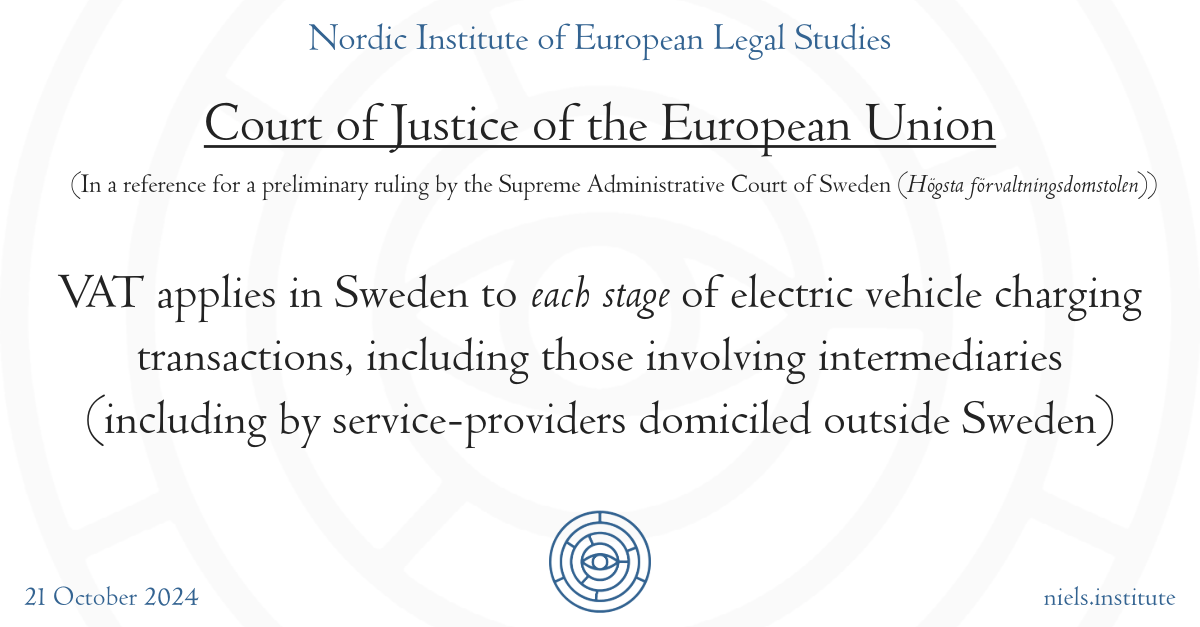
The Court of Justice of the European Union (CJEU) delivered its judgment in Case C-60/23, Digital Charging Solutions on 17 October 2024, referred to it by the Supreme Administrative Court of Sweden (Högsta förvaltningsdomstolen). The Court was being asked to clarity the interpretation of the VAT Directive on the taxability of links in the supply of electricity to charge an electric car at charging points.
The judgment clarifies that this supply of electricity should be treated as occurring at each stage of the transaction chain, including intermediary companies (including by service providers domiciled outside Sweden). Consequently, the electricity is supplied first by the charging point operators to such operators, and then by the operators to the end users, with each stage being subject to VAT in the Member States where the charging takes place, in this case, Sweden.
Background
The applicant before the referring court in this case is a German company (not established in Sweden), Digital Charging Solutions, that offers consumers access to a network of charging points for electric vehicles. It does not operate the charging points itself, but rather, enters into contracts with charge-point operators.
On the ground in Sweden, the company supplies users with a card and an IT application for authentication, enabling them to charge their vehicles at these points. Digital Charging Solutions invoices users monthly for the electricity consumed and a fixed fee for access to the network and related services.
The company is challenging a decision of the issued by the Swedish revenue board (Skatterättsnämnden), which had decided that the supply made by the applicant constituted a complex transaction principally characterised by ‘the delivery of electricity to users and that the place of delivery was to be regarded as being in Sweden’. The Swedish tax authority (Skatteverket) agreed with this decision.
Digital Charging Solutions, however, disagreed. For it, there was two separate issues here. First, the ‘supply’ of electricity, and second, the ‘supply’ of a service (access to the network of charging point). Thus, the company was of the view that only the supply of the electricity, the former, was to be taxed in Sweden.
For the company, its argument that the transaction should be split into two separate supplies: the supply of electricity and the supply of services (access to the network), meant that if its interpretation was accepted, only the supply of electricity should be taxed in Sweden.
Opinion of the Advocate General
Advocate General Ćapeta delivered her Opinion in April 2024. I have previously analysed her Opinion here.
Whilst analysing the various lines of technical case-law here under EU VAT law, Advocate General Ćapeta argued that two potential models sit the situation at hand.
First is the ‘buy and sell model’. For her, this
‘implies successive sales…[and]…requires recourse to the fiction that the right to dispose of electricity as owner was transferred from the [charging point operatiors] to [Digital Charging Solutions], which enables the latter to then sell the goods at issue.’ (para. 50).
Second however, she found the ‘commissionaire model’ to be also suited to present case. This is where a transaction involves an agent as the intermediary between a consumer and charge-point operators, noting that there are two types within this model: a ‘sales commissionaire model’ and a ‘purchase commissionaire model’.
In finding that Digital Charging Solutions was engaging in a ‘purchase commissionaire model’, she stated that,
‘it appears that both conditions – the presence of agency and the identity of supplies – are fulfilled in the circumstances of the present case and, consequently, the transactions at issue fit…[that]…model‘. (para. 69).
Given that two models were thus available, she then had to ponder which model applied. For her, she concluded that,
‘for the business model such as the one in the present case, the commissionaire model as described in Article 14(2)(c) of the VAT Directive is the most suitable VAT treatment.’ (para. 73).
Judgment of the Court
The CJEU addressed two matters. The first in concurrence with the Advocate General. The second, less so.
First, whether the supply of electricity for charging an EV at a public charging point constitutes a ‘supply of goods’ under Article 14(1) and Article 15(1) of the Directive. In its analysis, the Court reaffirmed that the supply of electricity for charging an EV constitutes a supply of goods. This interpretation aligned, according to the Court, with the definition of ‘supply of goods’ as the transfer of the right to dispose of tangible property as an owner. The Court emphasised that electricity, under Article 15(1) of the Direct, is treated as tangible property. Therefore, the transaction enabling the user to consume electricity for vehicle propulsion qualifies as a supply of goods. Consequently, the supply of electricity for charging EVs constitutes a supply of goods under Article 14(1) and Article 15(1) of the VAT Directive. This aligned with the Advocate General’s view on the classification of electricity as a supply of goods.
Second, however, the Court considered whether such a supply, when involving an intermediary company, should be deemed present at all stages of the transaction chain, even if the user decides on the quantity, time, and place of the electricity purchase. To answer this, the Court examined the role of intermediaries in the transaction chain. It considered whether the supply of electricity should be viewed as a series of successive supplies involving the charging point operators, the company, and the end users.
The Court noted that the contractual relationships and invoicing methods indicated that the company acted as an intermediary, purchasing electricity from the operators, and reselling it to the users. The Court highlighted that the economic reality of the transactions should guide the VAT classification. Thus, it observed that the company provided users with access to the charging network and related services, invoicing them separately for electricity and a fixed fee for network access. The fixed fee was independent of the quantity of electricity consumed, suggesting that the services provided were distinct from the supply of electricity.
As a result, the Court found that the circumstances in the present case differed from those in prior case-law. In particular, the absence of a credit mechanism, and the fixed fee structure, distinguished the transactions from those involving financing or credit arrangements. Ultimately therefore, the Court concluded that the supply of electricity for charging EVs, facilitated by an intermediary like the company, should be treated as a supply of goods at each stage of the transaction chain.
This means that the electricity is deemed to be supplied first by the charging point operators to the company; and then by company to the end users. For the Court, he intermediary’s role as a commission agent, acting in its own name but on behalf of the users, supports this interpretation.
Analysis
There is a noted difference between the Opinion of the Advocate General and the judgment of the Court. The latter focused on treating the transactions as successive supplies of goods, whereas the Advocate General emphasised the intermediary role and the potential application of the commissionaire model.
The judgment of the Court can be considered a victory for the Swedish Tax Authority, as the Court ruled that the supply of electricity for charging electric vehicles constitutes a supply of goods and that this supply should be treated as occurring at each stage of the transaction chain, including the intermediary company.
Since the supply of electricity is considered a supply of goods, and the company is involved in the transaction chain, the place of supply is Sweden, and thus, taxed in Sweden.
But the judgment also has implications for the VAT treatment of EV charging services across the EU more generally. For the judgment the clarifies that the supply of electricity for charging EVs constitutes a supply of goods, even when intermediaries are involved; and also, underscores the importance of considering the economic reality of transactions, and the contractual relationships between parties.
Read the judgment
The judgment of Court of Justice of the European Union (CJEU) in Case C-60/23, Digital Charging Solutions, referred to it by the Supreme Administrative Court of Sweden (Högsta förvaltningsdomstolen), and delivered on 17 October 2024, can be read here.