
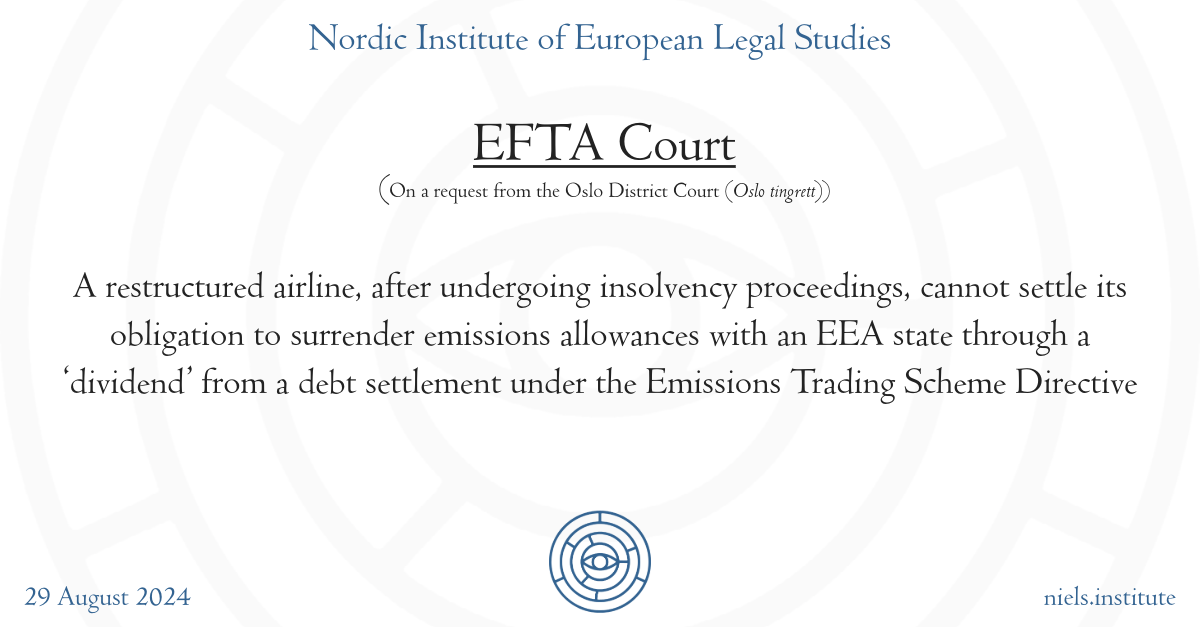
On 9 August 2024, the EFTA Court rendered its judgment in Case E-12/23, Norwegian Air Shuttle ASA v the Norwegian State. In its judgment, the EFTA Court ruled that when an involvent company is restructured, the surrender of an airlines emissions allowances cannot be settled by a dividend of a debt settlement.
The case was referred to the EFTA Court by the Oslo District Court (Oslo tingett) in a dispute between a Norwegian domiciled airline transport, Norwegian Air Shuttle Asa, between known as ‘Norwegian’, and the state of Norway, or more specifically, the Ministry of Climate and Environment.
Law
An interpretation was being sought of a provision of the Greenhouse Gas Emission Allowance Trading Directive, also known as the Emissions Trading Scheme Directive (Directive 2003/87) (‘the Directive’). More specifically, the referring court wanted to know whether Article 12(2a) of the Directive 2003/87 prevents EFTA-EEA states from having national laws that provides for an obligation that a company, that has been restructured after an insolvency, to be settled by dividend in a compulsory debt settlement.
Article 12(2a) of the Directive at the time stated that,
‘Administering Member States shall ensure that, by 30 April each year, each aircraft operator surrenders a number of allowances equal to the total emissions during the preceding calendar year from aviation activities listed in Annex I for which it is the aircraft operator, as verified in accordance with Article 15. Member States shall ensure that allowances surrendered in accordance with this paragraph are subsequently cancelled.‘
Article 12(2a) does not appear in the consolidated version of the Directive any longer because it was deleted by Directive 2023/959. That said, it was applicable at the time of the facts of the present case.
Facts
In February 2020, Norwegian was allocated its typical greenhouse gas emissions allowances, and were placed in the company’s allowance account in the greenhouse gas emissions allowance registry. By the end of April every year, airline operators were required to surrender allowances according to their reported emissions from the preceding year according to national law. Between February 2020 and April 2020, the COVID outbreak occurred.
In light of COVID, Norwegian was in a precarious financial situation, and it entered into an out-of-court restructuring process in agreement with its creditors. This was done via Norwegian and Irish restructuring laws.
The Ministry of Climate and Environment of Norway were of the view that the Directive in question does not allow for extensions to the time limit or other exemptions from the obligation to surrender emissions allowances. Nor, in the Ministry’s view, is there any margin to refrain any public body, like the Norwegian Environment Agency, from imposing an administrative penalty for failure to surrender them, as that is what is provided for by national law.
During this process, Norwegian had offered to settle the obligation that Norway views was upon it by offering to surrender allowances for emissions by way of a ‘dividend’ as part of a compulsory debt settlement in connection with its restructuring. This offer of the airline was declined.
The Ministry of Climate and Environment of Norway therefore agreed with a decision of the Norwegian Environment Agency on 16 December 2022 that imposed a ‘penalty’ of 400m Norwegian kroner (NOK) (€34m, approx.) for not surrendering its greenhouse gas emissions allowances. It is this decision that Norwegian are seeking to be set aside (annulled) before the national court.
Judgment of the EFTA Court
The EFTA Court stated, much like the CJEU previously, that the Directive in question,
‘seeks to reduce greenhouse gas emissions into the atmosphere to a level that prevents dangerous anthropogenic interference with the climate system and the ultimate objective of which is protection of the environment‘ (para 36).
Furthermore, it stated that,
‘accurate accounting is inherent in the very purpose of…[the]…Directive‘ (para. 40).
From there, the EFTA Court got the heart of the case. In that Article 12(2a) implies an ‘obligation’ which ‘must be applied particularly strictly’ (para. 42). And from there, it stated,
‘It is worded unambiguously in Article 12(2a)[,] and is an obligation to which that [D]irective attaches a specific penalty under Article 16(3), whereas the penalty for any other conduct contrary to its provisions is left to the discretion of EEA States under Article 16(1), which must nonetheless be effective, proportionate and dissuasive‘ (para. 42, continued).
From there, it held that,
‘It follows from the structure and general scheme of…[the]…Directive…that the legislature viewed the surrender obligation provided for in Article 12(2a) and the lump sum penalty enforcing that obligation provided for in Article 16(3) as strict obligations without any flexibility in order to prevent certain operators or market intermediaries from being tempted to circumvent or manipulate the system by speculating abusively on prices, quantities, time limits or complex financial products which tend to come about in any market‘ (para. 46).
Therefore, in the operative part of the judgment, it ruled that the provision of the Directive,
‘must be interpreted as precluding national legislation from providing that the obligation to surrender emissions allowances may be settled by dividend in a compulsory debt settlement in connection with the restructuring of an insolvent company‘.
This ruling was ultimately the positive propagated by Norway, Iceland, the EFTA Surveillance Authority (ESA), and the European Commission.
The judgment
The judgment of the EFTA Court in Case E-12/23, Norwegian Air Shuttle ASA v the Norwegian State, delivered on 9 August 2024, can be read here.
Suggested citation
Graham Butler, ‘EFTA Court: A restructured airline, after undergoing insolvency proceedings, cannot settle its obligation to surrender emissions allowances with an EEA state through a ‘dividend’ from a debt settlement under the Emissions Trading Scheme Directive’, Nordic Institute of European Legal Studies, 29 August 2024.